If you are in a position of leadership and influence, consider it your responsibility to keep your team motivated consistently.
Every career experience is deeply significant in understanding and expanding your vision. As a Consultant & Mentor, my years as a Ballroom Dance Educator & Trainer have been truly insightful in understanding teamwork and collaboration and the values of direction and motivation from a leadership perspective in team performance.
Here are a few tips to manage & motivate your team.
Attitude: A team is a set of individuals who are meant to align towards a vision and mission. Start of by getting the hiring process right. Hire the people with the right attitude.
Connection : Begin to connect with your team with genuine interest in their work plan, issues and tasks at hand. You are more likely to understand the pain points, their strengths and find proper resolutions
Trust building : Building trust in your team starts with a leader who knows when to engage and when to back off. Trust creates responsibility and makes team members accountable.
Safety : A team that is ensured, mental, physical, social, environmental safety feels well-supported. Understand how important it is for every member to sense the safety so that your team can take steps with confidence.
Respect: Give respect to get respect. Create a platform to collaborate without character assaults and biased opinions.Always remember there is the benefit of doubt.
Non-judgmental : Avoid & Reduce personal bias and judgements in assumptions from affecting your team. Be inclusive and create a diversity in the team such that it becomes a source of strength.
Attention: Care to pay attention and nurture your team. Be available and wholly present to guide, mentor your teams through their tasks and issues. But reduce dependencies.
Appreciation: Last but not the least care to celebrate their small & large wins, take time to appreciate the good work.
Pareidolia(/ˌpæriˈdoʊliə/,[1]USalso/ˌpæraɪˈ-/[2]) is the tendency for perception to impose a meaningful interpretation on a nebulous visual stimulus (so that one sees an object, pattern or meaning where in fact there is none).
Ref Wiki Seeing familiar objects or patterns in otherwise random or unrelated objects or patterns is called pareidolia. It’s a form of apophenia, which is a more general term for the human tendency to seek patterns in random information. Face pareidolia seems to be a universal phenomenon.
Finding faces in the most unexpected places, may have an evolutionary angle of a need to seek familiarity in the wake of the unknown, for a psychological safety. Or finding faces in the bonnet of a car that makes it look more fun, friendly & smiling.
Maybe piecing the possibilities together to make sense is an illustration in the illusion… Whatever the case creativity of the human mind is infinite in its potential to conjure up endless possibilities out of practically nothing concrete.
In the ability to create abstract associations to integrate and create and merge a more meaningful interpretation for ourselves,makes it an art of limitless possibilities.
When I started listening to my inner calling, I realized all that which makes me happy to be in this present moment … makes me at my receptive, attentive, creative, connective, positive best.
At this juncture I guess the moment I feel most centred is the moment I connect with the art of dancing whether with words or movement … in whatsoever way possible. Be it in thoughts, action or deeds, like learning a new dance form practicing, teaching dance techniques to the interested, imparting a workshop, sharing a dance, creating new patterns or even writing about it!
Somehow a sense of serene alertness sets in and yet it manages to keep me in the state of joyous flow.
I realize this space to be my healing abode that which lets me be me, as expansive as I want to be! I am aware how much my connect with dancing is growing. I am thankful to those who have helped to be where I am … and hopefully evolving in the being!
We are all beautiful unique beings, and it is important to understand that which makes us unique is our distinct differences…
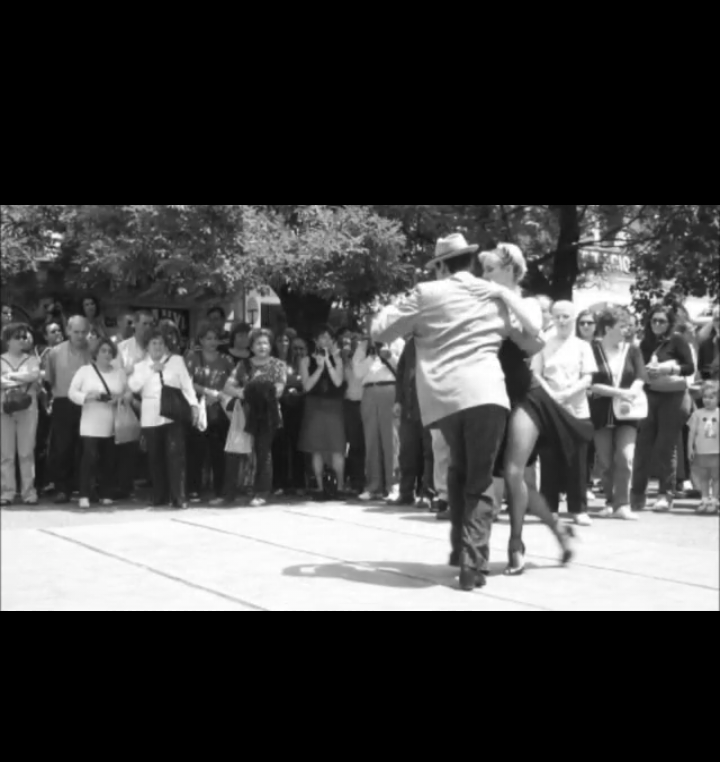
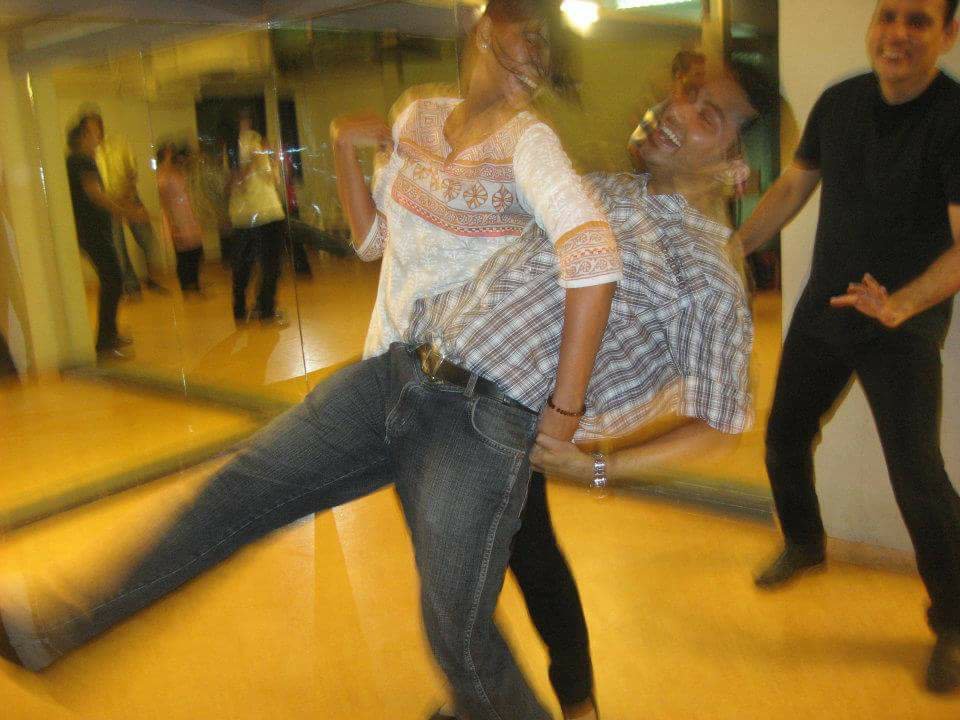
Likewise, with regard to partner dancing, there are many different perspectives as far as learning is concerned.
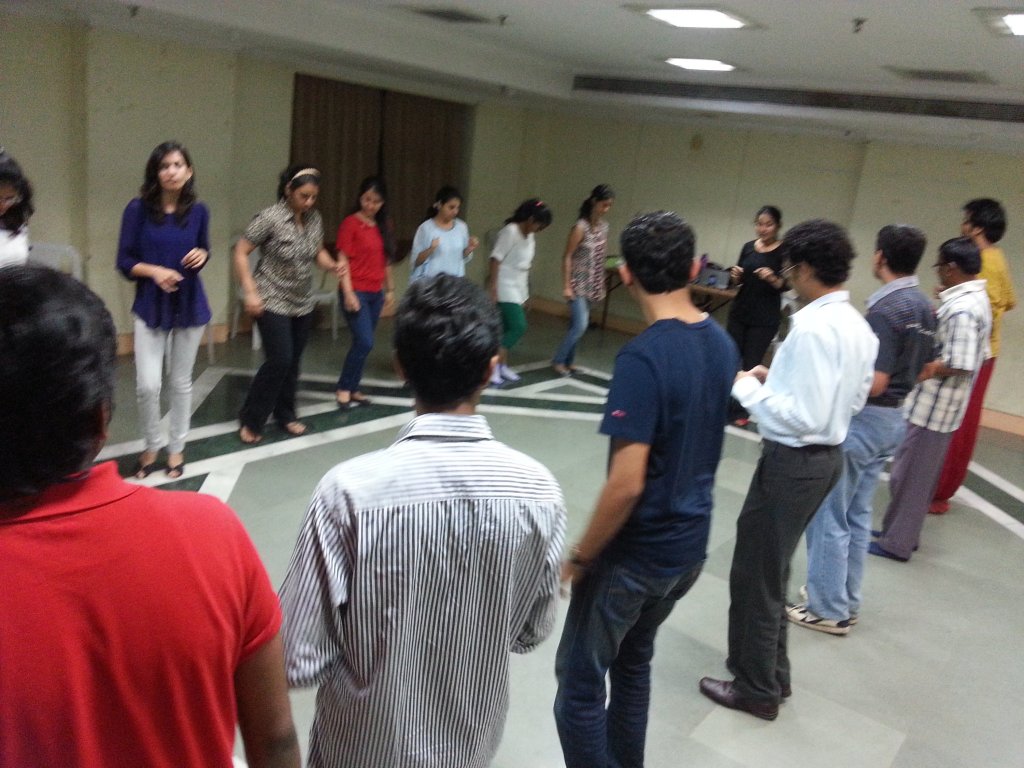
A Beginner Dance workshop
From Social Dancing (which I identify naturally with,possibly due to my own personal traits) to Show dancing at performances, an ideal platform for people who like to be at their theatrical , glamorous best and love to entertain, to Competitive dancing which would be ideal for those who would like a rigorous and vigorous , athletic approach to dance training, where the syllabus is watertight and there are judges to keep scores and evaluate your training in different levels and where there are certificates awarded for levels completed with proficiency in perfect execution of well-rehearsed patterns.
Each of these are beautiful pathways and has its own takers according to and as per the individual’s nature. The scope of each is very different and yet the health benefits are common to all with consistent practice.
But my point here is, that among them the important factor which differentiates Social dancing to choreographed sequences of the Exhibition and Show dancing and the Competition dances, lies in the expansion of the ability to accommodate , adjust and act according to the needs of the situation, which can be developed an applied very creatively in Social dancing … as you learn the art of partnering for e.g to lead and follow, no matter what the age, gender, height, weight or proficiency level is. This call’s for a heightened attentive response to stimulus …(average response time to a visual stimulus for the human brain is about 1.23 seconds or so for the human brain to body connection and response to happen).
Dancing socially is a natural way to bring out the creative potential in the dancers as there is no room for monotony to set in after a while, which could be possible in rigorous performance-based dance training, or with strict adherence to the syllabus in competition dances.
And yes … I love the fact that no longer is the old rigid viewpoint true of the leader being always in the lead and the follower always the follow … I hope to reach out and train and send out more people on the dance floor who realize the importance of equality in partner connections .. after all without a follower there can be no leader … I hope the word ‘Hijack ‘which technically could mean a follower taking over the job of the leading … is replaced with responsible ‘Alert Partnering ‘ which improvises the creative quotient of the dance partners …..and brings out the essence of great dancing!
Let us join hands to promote the simplicity of Dance a Spatial Art, for I do believe that it’s so much more than just a floor craft.
All across the world April 29th every year is celebrated as the International Dance Day… as I share this as a dedication to the Art of Dance …do remember to keep the spirit of dance in your heart and keep on dancing!






























 Savvy Raj
You must be logged in to post a comment.